District energy
District energy
State of the art
Transition to low-temperature heating networks and high-temperature cooling networks, coupled with gas and electricity networks,
Integration of renewable & waste heat sources,
Digitalization & smart control.

Our focus
- Modeling and simulation of gas, district heating and cooling networks,
- Integration of renewable energy sources (i.e. solar thermal, geothermal, waste heat, etc.),
- Development of thermal energy storage and load management solutions (flexibility),
- Design of low-temperature (4th/5th generation) district energy systems,
- Case studies for transformation from lower to higher generations,
- Implementation of smart control systems (AI, digital twins, predictive algorithms),
- Testing and optimization of small system components (heat exchangers, pumps, valves, heating substations),
- Consulting services for municipalities, utilities, and industry,
- Simulations of decentralized and hybrid systems combining district and individual energy sources,
- Calculation and comparison of Levelized Cost of Heat (LCOH),
- Socioeconomic and environmental impact assessments,
- Consumer behaviour studies,
- Organizing stakeholder workshops and training sessions,
- Participation in standardization efforts and advisory panels.
As our current work is mostly focused on numerical modeling and simulations, we share two open-source tools here:
- pandaprosumer: https://github.com/e2nIEE/pandaprosumer
pandaprosumer is an open-source modeling tool, that enables modeling of sector-coupling prosumer components in energy systems. The framework comes with a library of different predefined sector-coupling components, but also enables users to create own components based on the pandaprosumer framework. It also comes with a logic to simulate different combinations of these components with each other and different inputs (e.g. a heat demand timeseries) and outputs (e.g. power load timeseries on the powergrid). LAHDE developed (boster) heat pump model.It extends the libraries pandapower and pandapipes , was created at Universität Kassel, Fraunhofer IEE. This research was supported by the SENERGY NETS project, which has received funding from the European Union’s Horizon Europe research and innovation programme under grant agreement No. 101075731.
- DisCoNetHeat: https://github.com/lahde-unilj/DisCoNetHeat
 This app has been developed by LAHDE within 3DIVERSE (Decentralisation, Diversity and Dynamic Load Regulation – Novel Approaches to Tangible Energy Transition with Diversification of Production Sources) project, funded by the European Union’s LIFE Programme (Grant Agreement No. 101077343).
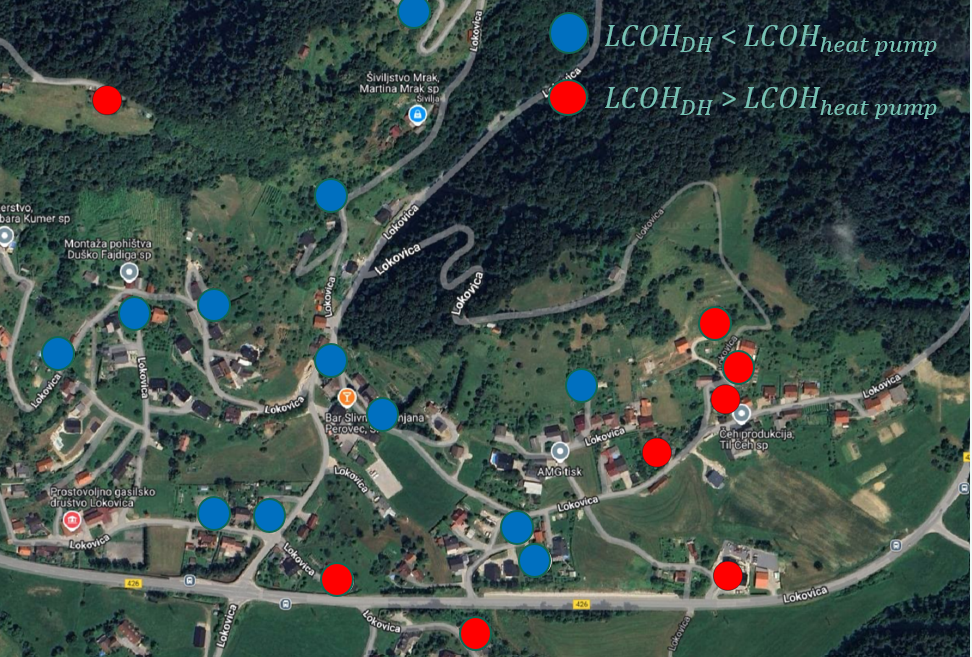
This app serves for identification of potential disconnections form district heating networks. This app generates a QGIS map based on coordinate and category data provided in an Excel file. The categories represent different Levelized Cost of Heat (LCOH) values, which are, in this example, assigned to either individual heating systems or district heating consumers. The purpose of this tool is to provide a clear, graphical representation of LCOH variations across a district heating network.
By visualizing this data spatially, the tool allows users to easily identify areas where the LCOH for district heating is higher than for individual heating. In such cases, the affected consumers or entire zones are more likely to disconnect from the district heating network, which can help stakeholders or network operators anticipate potential risks to network viability or plan future interventions. Different scenarios can be evaluated based on the different LCOH values.
Experts in the field